
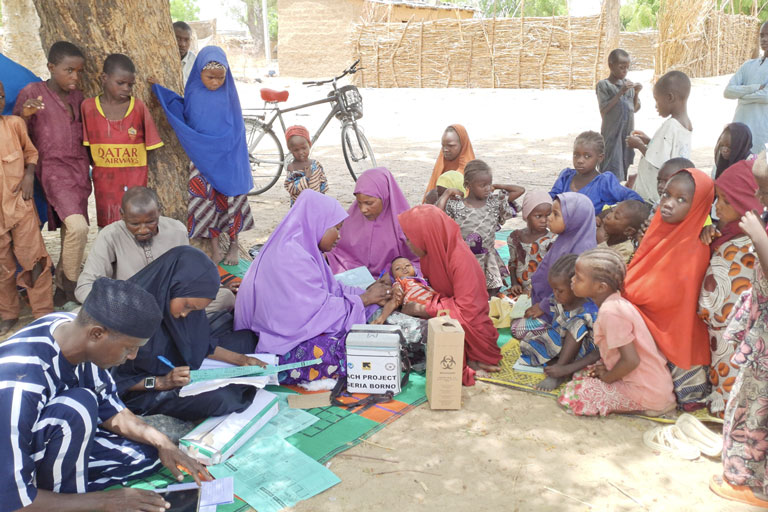
As the vehicle neared Basheti community in Dusuman Ward, Jere LGA, Borno State, one of the security-compromised communities where the Christian Health Association of Nigeria (CHAN) delivers vaccines, tension was high. The dusty, narrow road was lined with small huts, and eerily quiet. Just weeks before, violent attacks between the localities of Rann and Gamboru had claimed many lives, with victims including 26 women and children.
At the end of April 2025, the CHAN team had administered 399,780 doses of Nigeria’s set of routine vaccines in Borno state, including 14,062 doses of yellow fever vaccines.
For the CHAN team, the constant threat of violence weighed heavily, making every kilometre a test of determination. But the mission was clear: bring life-saving vaccines to children in Basheti, a community unreached by government immunisation efforts due to conflict-engendered mistrust.
This mission is part of the REACH project, implemented by CHAN with support from the International Rescue Committee (IRC) and funded by Gavi, the Vaccine Alliance, which is committed to ensuring children in missed communities impacted by conflict and crisis – like children elsewhere – receive the protection of vaccines.
But in Basheti, amid broader mistrust, scepticism of immunisation had grown. At the centre of the resistance was Bukar Usman*, a respected leader of the local Shuwa-Arab community. As a father of three and guardian of his people’s wellbeing, Bukar’s doubts carried weight far beyond his own family. Misinformation and fear had made him a strong opponent, convincing him that vaccines would do more harm than good. When the CHAN team first arrived, Bukar and other elders refused to talk and turned the team away.