Scenario analysis
When and where is the hazard expected to happen?
Since 28 February 2026, hostilities involving Iran, Israel, and the United States have intensied, characterized by coordinated strikes on strategic facilities, retaliatory missile and drone launches, aerial interceptions, and elevated military alert levels across the region. The geographic expansion of these developments has heightened instability beyond the primary areas of confrontation, resulting in diplomatic drawdowns, airspace restrictions, and strengthened defensive postures in several neighbouring states. While Iraq is not a direct party to the conict, its geographic position, strategic signicance, and the presence of international military interests increase its exposure to indirect and spillover eects.
Recent security-related developments inside Iraq, including reinforced security deployments, demonstrations in Baghdad, and reported aerial defense activity in northern areas such as Erbil, reect a progressively fragile operating environment. In addition, media reports and ocial gures from the Ministry of Health indicate that airstrike-related incidents within Iraq since the onset of the regional escalation have resulted in 11 fatalities and 33 injuries, highlighting the potential human toll of spillover eects. While large-scale displacement has not yet occurred, the situation remains highly volatile, and humanitarian needs could escalate rapidly if regional hostilities intensify, placing additional strain on vulnerable communities and local response capacities.
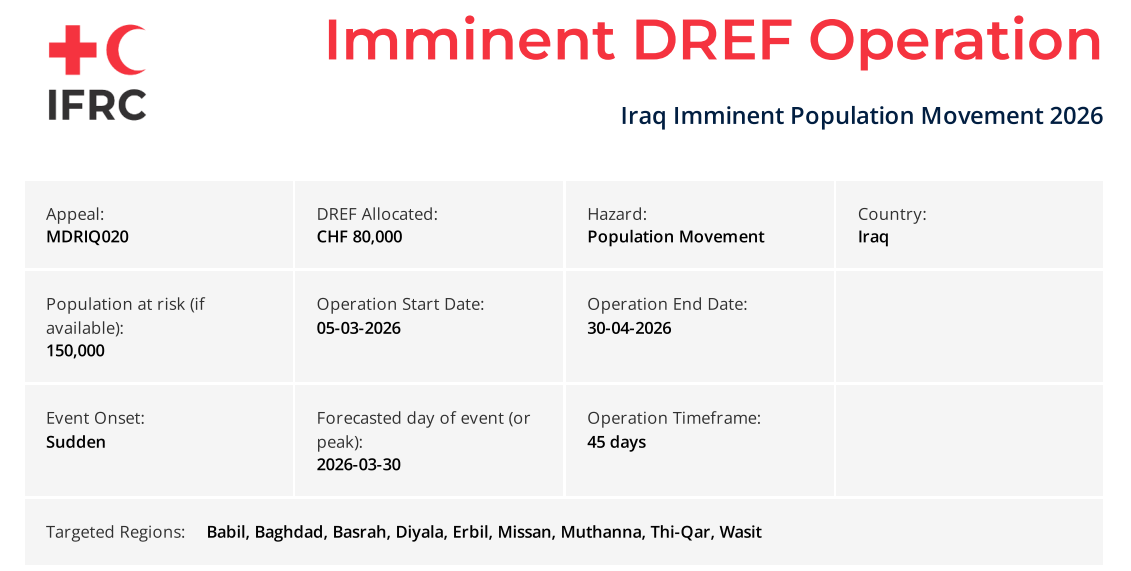
The Protection Room for CBRN and the High Leadership Committee for Civil Defense Aairs Management under the Prime Minister’s Oce have determined that nine governorates are at heightened risk: Erbil, Baghdad, Diyala, Babil, Wasit, Muthanna, Dhi Qar, Missan, and Basra. These governorates are considered sensitive due to their proximity to potential cross-border corridors, strategic infrastructure, transit routes, and limited surge capacity within humanitarian service structures. In this context, the most probable scenario in the near term is sudden cross-border arrivals or internal displacement that may place pressure on local systems. Two principal risk pathways could generate acute humanitarian needs.