A Decade After UNSCR 2286, the Promise to Protect Health Care in Conflict Remains Unfulfilled
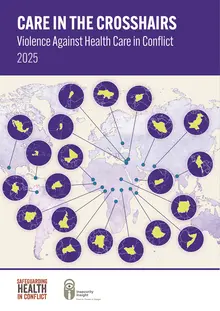
Care in the Crosshairs: Violence Against Health Care in Conflict in 2025, released today by the Safeguarding Health in Conflict Coalition (SHCC), documents 2,546 incidents of violence against or obstruction of health care across 33 countries in 2025, including 790 incidents where hospitals were damaged or destroyed and 455 health workers killed. International humanitarian law prohibits attacks on health care, a commitment all 15 UN Security Council members reaffirmed when they unanimously adopted Resolution 2286 ten years ago. Yet perpetrators are rarely held to account, even as some hospitals and health workers continue to be strategically targeted.
"In 2025, reported violence on health care rose in 13 countries. Today, as we release our 2025 findings, at least 18 first responders have been killed in Lebanon in sequential strikes targeting rescue workers responding to an initial air strike, while health facilities treating Ebola patients in eastern Congo are being set on fire as conspiracy theories about the origin of the virus spread online," said Christina Wille, Executive Director of SHCC member Insecurity Insight, which oversaw data collection and analysis processes for the report.
"When health workers are kidnapped, tortured, or killed, societies lose irreplaceable expertise not only for conflict injuries, but for the full range of health emergencies and basic needs that follow. War is already devastating to health, but attacking hospitals makes it doubly so: health needs surge while services are destroyed. Outbreaks spread, trauma rises, and preventative care is all but lost in these situations. This lasts for years, if not for decades," said Rohini Haar, Co-Chair of the SHCC and Adjunct Associate Professor at the University of California, Berkeley.
Kidnappings, Arrests, and Funding Cuts
In 2025, health workers faced escalating danger on multiple fronts: in addition to the 455 health workers killed, kidnappings rose 58 percent to at least 218 cases, with sharp increases in eastern DRC, Mali, Haiti, Pakistan, and Syria, as violence against health care attributed to non-state actors rose. More than 260 health workers were arrested or detained across 17 countries. At least seven died in custody in Ethiopia, Gaza, Sudan, and Syria. Since 2021, state actors have consistently been reported as being responsible for more violence against health care than non-state armed groups, and 64% of all violence against health care was attributed to states in 2025.
Compounding the crisis, USAID funding cuts and a broader decline in official development assistance forced the immediate closures of health services across conflict-affected areas, reducing essential services by up to 70 percent, in some settings. The cuts have also compromised the evidentiary record: in some countries, apparent drops in reported incidents likely reflect collapsed reporting capacity driven by funding cuts as well as insecurity and communication disruptions, and not improved security on the ground.
“Armed drones are not striking health facilities by accident.”
Armed drone strikes against health care surged 43% in 2025, accounting for 34% of all explosive weapons incidents affecting health facilities, up from 16% in 2024. Ukraine and Sudan drove much of that increase. In Sudan, incidents rose dramatically, from three to 24. In at least one case, first responders treating the wounded were hit in a deliberate follow-up drone strike. The civilian impacts of these drone strikes are large, as one doctor described: "Some days I see 20 patients; other days, after a missile or a drone hits, 200."