
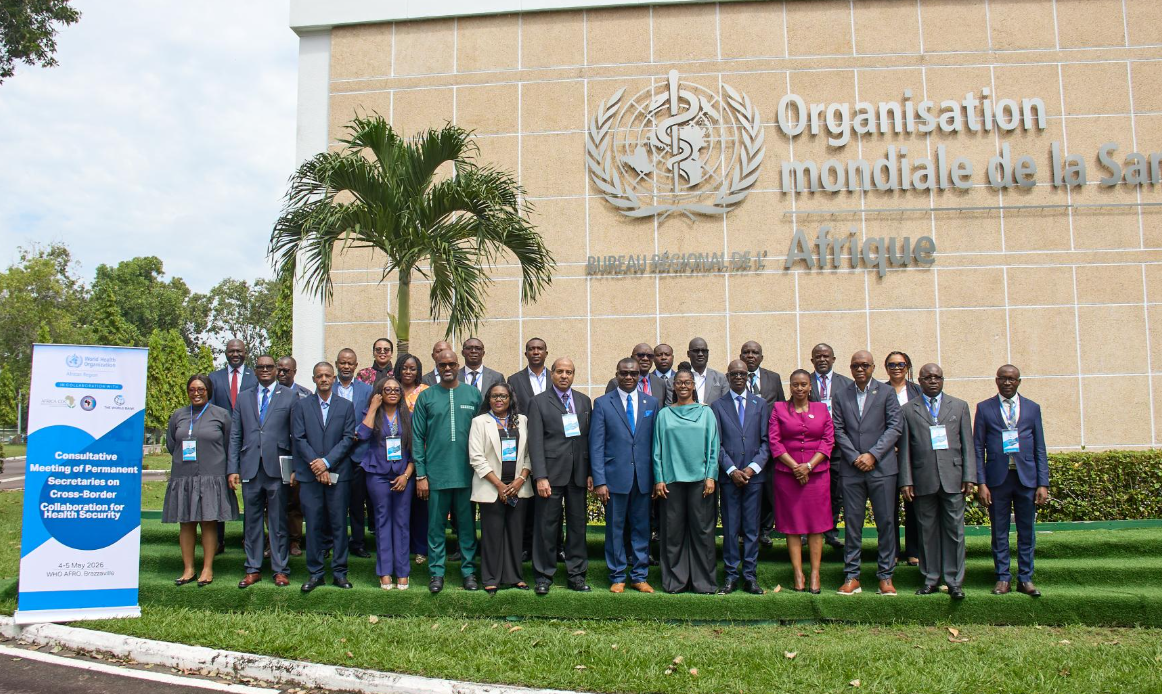
As health threats continue to spread across borders, countries are strengthening how they work together to prevent and respond to outbreaks.
Permanent Secretaries from 13 countries are meeting in Brazzaville, Republic of Congo, from 4 to 5 May 2026 for a high-level consultation on cross-border collaboration for health security. The meeting focuses on refining a proposed Memorandum of Understanding (MoU) to strengthen coordination for preparedness and response to health emergencies.
Recent outbreaks of mpox, cholera, Ebola disease and Marburg virus disease have shown how quickly risks in one country can affect others. With increasing population movement, climate-related shocks and humanitarian crises, outbreaks are no longer contained within national borders.
Preparedness now depends on how effectively countries share information, detect risks early and respond together.
While many countries have strengthened preparedness under the International Health Regulations (2005), coordination across borders remains uneven. Delays in data sharing, systems that do not communicate with each other, and challenges in deploying response teams and supplies continue to slow action. The consultation in Brazzaville aims to address these critical gaps.
“This meeting is an opportunity to assess how cross-border collaboration works today and how it must evolve. We need to ensure national systems connect, align and operate in real time. Implementation will require more than the health sector alone. We will engage all relevant sectors involved in cross-border activities to ensure full participation and coordinated action,” said Marie-Roseline Belizaire, Emergency Director, WHO Regional Office for Africa.
Hosted by the WHO Regional Office for Africa in collaboration with Africa CDC, the World Bank and ECSA-HC , the meeting brings together senior government officials from across the region, alongside partners, to agree on more structured and predictable ways of working together.