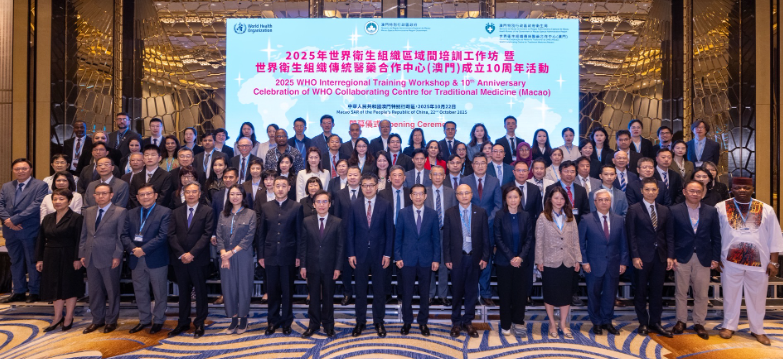
The World Health Organization (WHO) convened the Interregional Training Workshop on Ensuring the Quality and Safety of Traditional, Complementary and Integrative (TCI) Medicine Products from 22–24 October 2025 in Macao SAR, China. The workshop was organized as part of WHO’s ongoing efforts to strengthen regulatory systems and promote safe integration of traditional, complementary and integrative medicine (TCIM) into national health systems.
The training brought together more than 40 participants from 18 countries and two Special Administrative Regions (Angola, Brazil, Cabo Verde, China, Egypt, India, Indonesia, Iraq, Lao People’s Democratic Republic, Malaysia, Mozambique, Nepal, Pakistan, Poland, the Republic of Korea, Thailand, Timor-Leste, and Viet Nam, as well as Hong Kong SAR China and Macao SAR China), representing the six WHO regions. Participants included government regulators, technical experts, researchers, and representatives from WHO Collaborating Centres, who shared national experiences and explored practical approaches to quality assurance, safety monitoring, and evidence generation for TCIM products.
This interregional workshop contributes directly to the implementation of the WHO Global Traditional Medicine Strategy 2025–2034, endorsed by the Seventy-eighth World Health Assembly earlier this year. The Strategy provides a forward-looking framework for countries to strengthen research, regulation, and integration of traditional medicine into health systems, in alignment with the goals of universal health coverage and the WHO Fourteenth General Programme of Work.