In a crisis, every decision counts – especially relating to public health and social measures (PHSM)
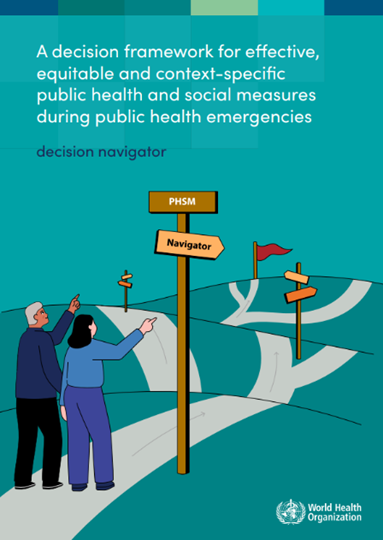
The World Health Organization (WHO) has published the PHSM Decision Navigator, a first‑of‑its‑kind framework designed to support governments in navigating complex decisions on PHSM during health emergencies.
Why PHSM decision-making is challenging
PHSM are vital in reducing the risk and scale of infectious disease transmission and lowering hospitalization and deaths. Examples include contact tracing, quarantine and isolation, mask use, ventilation, school or workplace measures, mobility restrictions and travel requirements.
While these measures are essential, decision-making on PHSM becomes particularly complex during rapidly evolving health emergencies, with incomplete information and under significant public and political pressure, especially when the pathogen is novel or poorly understood. In such contexts, guidance needs to be agile and responsive, developed and adapted based on emerging evidence and shifting epidemiological patterns. Decision-makers are frequently confronted with difficult trade-offs, having to balance measures that are:
─ effective but socially disruptive;
─ cost-effective but logistically burdensome;
─ beneficial for public health but economically disruptive; or
─ practical but inequitable or unethical.
Therefore, selecting and adjusting PHSM requires careful consideration of a complex array of factors, including the epidemiological situation, health system capacity, availability of medical countermeasures, along with resource availability, political and legal feasibility and public acceptance of the PHSM being considered.