
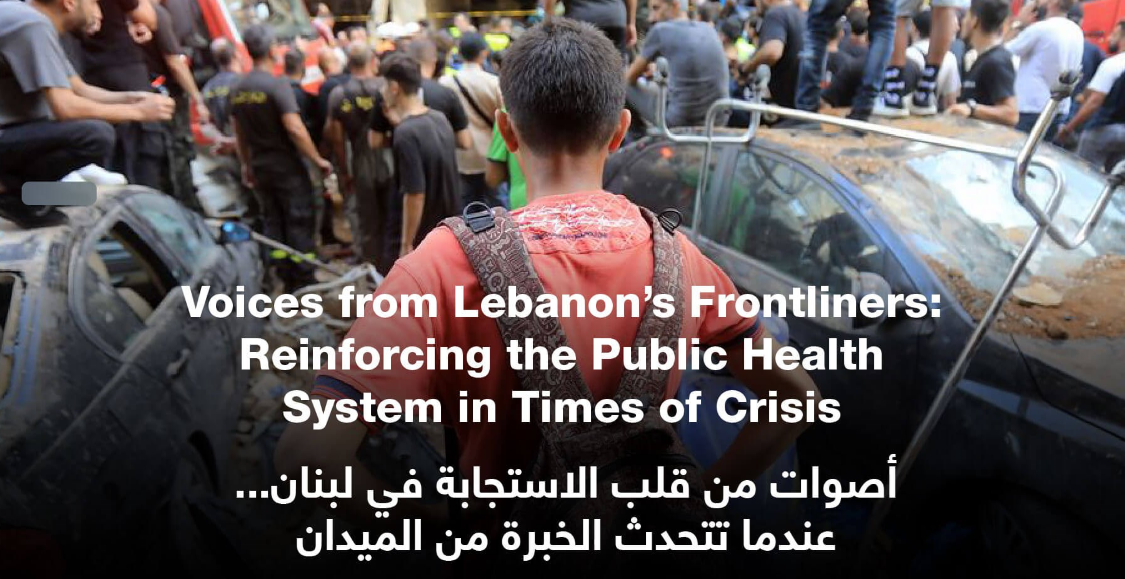
Lebanon continues to face complex and overlapping crises that place significant pressure on its public health system, making it increasingly important to continuously voice needs and highlight emerging gaps. In such fragile and evolving contexts, advocacy plays a critical role in ensuring that public health priorities remain visible, that vulnerable populations are not overlooked, and that evidence informs timely and coordinated action.
In this context, we present key insights from an interview with Dr. Kassem Chaalan from the Lebanese Red Cross, highlighting perspectives on strengthening early warning and surveillance systems, addressing gaps in women’s and children’s health, and reinforcing the resilience of essential health services during emergencies and beyond.
1) How can strengthening the public health system and early warning functions improve the timely detection of health threats in Lebanon during emergencies and beyond, and what key actions are needed to sustain these capacities in crisis settings?
Strengthening the public health system and early warning functions is essential for detecting health threats early, especially during emergencies when population movement, overcrowding, disrupted services, and poor WASH conditions increase the risk of outbreaks. In Lebanon, early detection depends not only on technical surveillance systems, but also on community trust, two-way communication, and the ability of people at community level to report unusual events quickly and safely.
Timely detection can be improved by reinforcing coordination and interoperability between community actors, municipalities, PHCCs, hospitals, NGOs, the Lebanese Red Cross, and the Ministry of Public Health, particularly the Epidemiological Surveillance Unit. Community Based Surveillance can play a critical role by enabling trained community focal points and volunteers to identify and report early warning signs such as clusters of diarrhea, suspected measles, hepatitis A, food poisoning, respiratory symptoms, or other epidemic-prone diseases.
To sustain these capacities in crisis settings, key actions are needed:
Surveillance should therefore not be seen as data collection only. It must be linked to timely public health action, so that alerts are verified, investigated, communicated back to communities, and followed by appropriate response measures. This helps Lebanon move from a reactive model to a more risk informed, anticipatory, and resilient public health system.
2) In the context of ongoing emergencies in Lebanon, how can the public health system better identify and address gaps affecting women’s and children’s health, while supporting timely response and building more resilient essential health services?
During emergencies, women and children are among the most affected groups because they face higher risks related to interrupted vaccination, malnutrition, pregnancy care, unsafe living conditions, limited access to PHCC services, mental health and psychosocial stress, and increased exposure to communicable diseases. These risks are even higher for displaced populations, persons with disabilities, female headed households, refugees, migrants, and communities living in hard-to-reach or underserved areas.
The public health system can better identify gaps affecting women and children through triangulation of different data sources, including:
These sources help identify where children are missing routine vaccines, where caregivers lack access to reliable health information, where women face barriers in accessing maternal and reproductive health services, and where families need referrals for nutrition, mental health and psychosocial support, or other essential care.