Iraq declared an environmental emergency over Tigris-Euphrates pollution on 24 September 2026, the latest of several responses this year. Enlil traces the pattern and what enforcement would actually require.
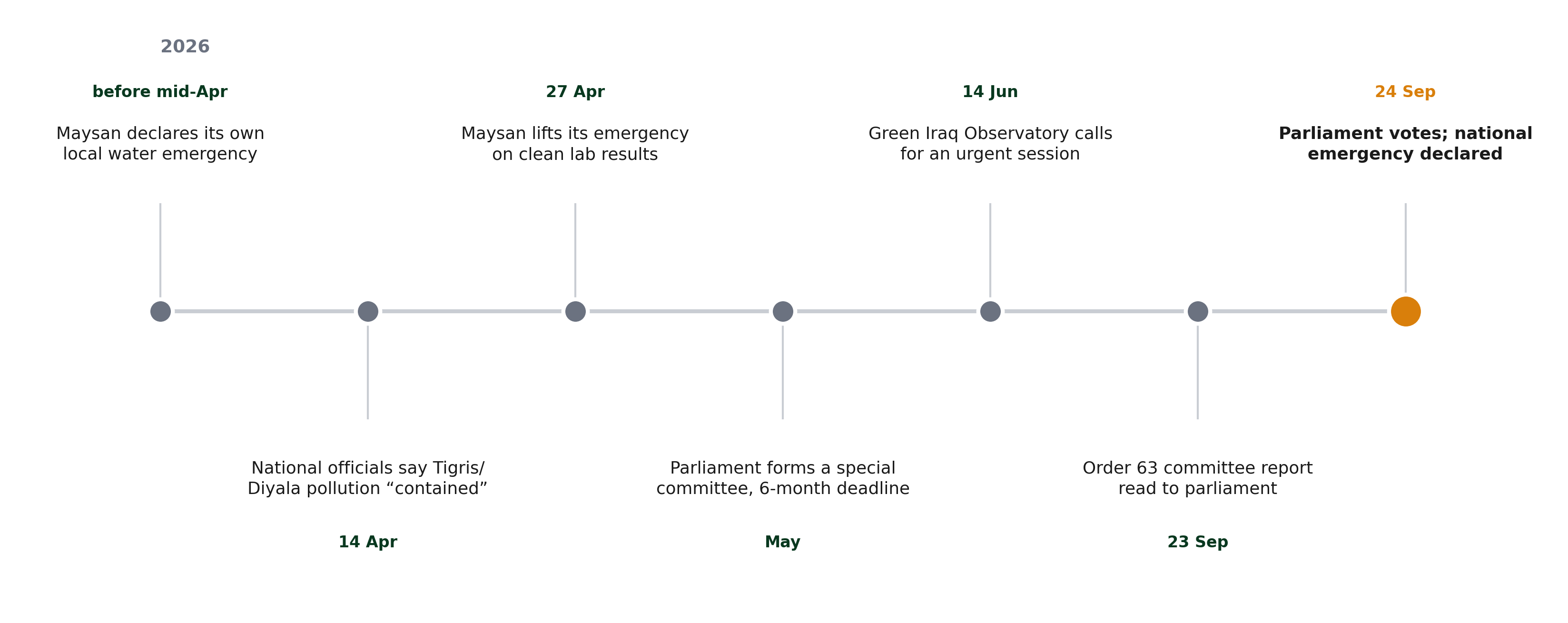
Iraq's parliament received the report of the Order 63 committee on Wednesday, 23 September, one of four items on that day's agenda alongside a laboratory technicians' bill and an employee-leave law. The committee had been tasked with identifying the causes of pollution in the Tigris and Euphrates, naming the parties responsible, and reviewing what had already been done to limit the damage. A day later, on Thursday, parliament voted to approve its recommendations, and Environment Minister Sarwa Abdulwahid — in the post since mid-May — declared a state of environmental emergency. “Environmental conditions have reached a stage that requires exceptional measures,” she said. The government's response includes a platform for documenting pollution violations and identifying their sources, new water-quality monitoring stations modeled on Iraq's existing air-quality network, and what officials describe as a one-year government action plan.
That declaration is a real step: a named minister, a dated vote, and at least two concrete deliverables — a public violations platform and physical monitoring stations — that can be checked later against whether they actually exist. But the emergency itself is not a new discovery, and it is not even the first time this year that the word “emergency” has been formally applied to this same pollution.