
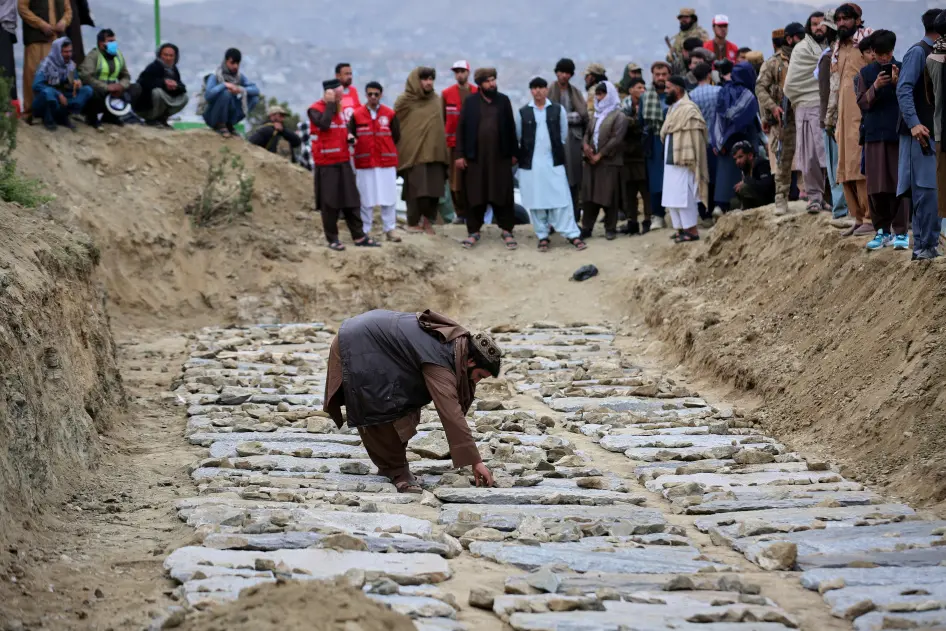
A Pakistani airstrike on a drug treatment center in Afghanistan on March 16, 2026, was an unlawful attack and a possible war crime, Human Rights Watch said today. International agencies reported that at least 143 people were killed and more than 250 injured, most of them patients. Pakistani authorities should promptly and impartially investigate the incident and hold all those responsible for wrongdoing to account.
The Pakistan air force attack struck the Omid Drug Rehabilitation Center, a 2,000-bed treatment complex in eastern Kabul that has operated since 2016 on the premises of a former NATO base known as Camp Phoenix. A center employee told Human Rights Watch that three buildings were hit: a large building used as a dining area, a building that accommodates 450 patients, and a guard room where eight men were working. On March 17, Pakistan’s federal minister of information and broadcasting, Attaullah Tarar, posted on X that Pakistan had carried out “precision airstrikes” on “technical support infrastructure and ammunition storage facilities,” but did not mention the Omid facility.
“The available evidence indicates that the Pakistani airstrike against a well-known Kabul medical facility killing dozens of patients was unlawful,” said Patricia Gossman, senior associate Asia director at Human Rights Watch. “Pakistani authorities need to carry out an impartial investigation to determine why it hit a drug treatment center filled with civilians and who should be held to account.”
The center employee said that over 1,000 patients were at the facility at the time of the attack, but the actual number is uncertain. An official with an international agency said that many patients were in the dining area to break the Ramadan fast. The United Nations describedthe “complete destruction of one block that housed adolescents receiving drug treatment.”
Afghanistan’s poor health infrastructure and lack of DNA testing capacity have hampered identification of the dead. An Afghan forensic doctor at the Public Health Ministry said that medical personnel could not identify some bodies. The father of one victim said: “We searched all hospitals in Kabul…[but] we couldn’t find him. Then we went to forensic medicine, and his body was there. … They showed us many bodies before we could identify him.”