
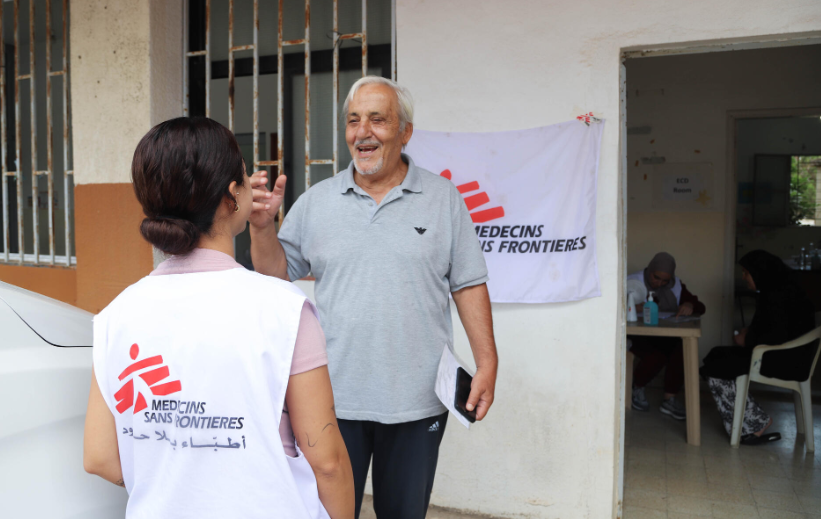
“I came back to repair the damage to my house,” says Abdel Karim, his words almost drowned out by the hum of an Israeli drone overhead. “But without safety and the ability to afford basic things like medicines, how can anyone really start over?”
One year has passed since Israel escalated its war in Lebanon, but the humanitarian crisis is far from over. Despite the ceasefire agreement in November 2024, Israeli attacks are almost a daily reality, hindering people’s ability to recover and restricting their access to care. Israeli forces are still occupying several points along the southern border, preventing people’s return and leaving more than 82,000 displaced.1
Abdel Karim returned to his town in Bint Jbeil district of the Nabatiyeh governorate – one of the hardest hit areas – where he now receives his chronic disease medications from a Médecins Sans Frontières (MSF) mobile clinic. Thousands of families across Lebanon struggle to access healthcare as they attempt to rebuild their lives amid or after displacement, loss, and uncertainty.
Communities in Lebanon still face uncertainty
In southern Lebanon, war has devastated infrastructure, including healthcare facilities. At the height of the escalation, eight hospitals, mostly in the southern areas, were evacuated, while 21, or around 13 per cent of the country’s total were damaged, drastically reduced their services, or were forced to close.2 Another 133 general healthcare facilities also shut their doors, and Nabatiyeh alone lost 40 per cent of its hospital capacity. Today, many damaged facilities remain closed, and many need rehabilitation.
After the escalation, MSF set up new activities in the hardest-hit governorates—Nabatiyeh, the South, and Baalbek-Hermel, while maintaining our presence and provision of services in Beirut, Bekaa and the North. In the southern governorates, where available services remain financially out of reach for many returnees, we set up mobile clinics to ensure communities’ access to vital medical and mental health services. MSF is also rehabilitating and supporting three general healthcare centres.