
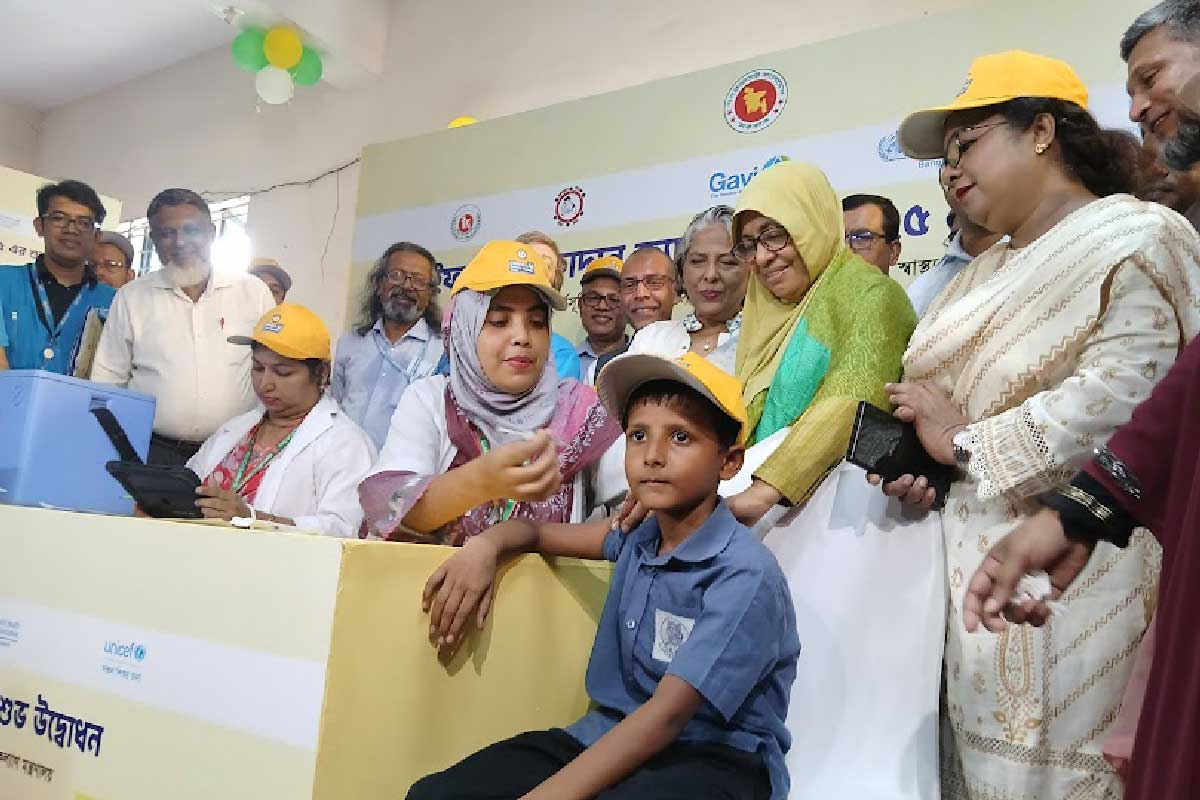
Fifty million children countrywide were offered the typhoid conjugate vaccine (TCV) during the November campaign, which marked that jab's introduction into the national immunisation schedule.
“My two children most often suffer from fever. We were worried about it. That’s why I brought them here – to get them vaccinated against typhoid. It makes me free from worries about my children,” said Sumaya Akter from Hazaribagh in Dhaka.
She had brought her seven-year-old daughter Annur Hossain Sejda to an immunisation point set up at Azimpur Government Girls’ School, to receive her dose of the typhoid conjugate vaccine (TCV). It was 12 October, the first day of the first-ever countrywide TCV campaign, which aimed to protect 50 million Bangladeshi children aged nine months to 15 years over the course of two weeks.
Earlier that day, just a few hundred metres away at the Sir Salimullah Muslim Orphanage, Health and Family Welfare Adviser of the Interim Government, Nurjahan Begum had spoken at the launch event of the campaign. “Around 8,000 die of typhoid disease every year,” she had said. “Most of the patients are between nine months and 15 years of age.” Vaccination with TCV, she added, would prevent both fatalities and hospitalisations.
Mehedi Hassan, a student of class III and an resident of the Sir Salimullah Muslim Orphanage, was one of the first to receive the vaccine, and reported that he had felt no pain at all. “I’m happy about taking this vaccine as it will save me from typhoid,” he told VaccinesWork. A single dose is considered to offer protection for a period of several years.
Globally, typhoid, which is caused by the food- and waterborne bacterium Salmonella typhi, is estimated to kill about 110,000 people each year. It also sickens millions, and amid high and rising rates of antimicrobial resistance, managing cases of the disease can be a difficult and costly affair.
According to a 2024 retrospective observational study published in PLOS Neglected Tropical Diseases, rates of resistance to some important first-line drugs remain high in Bangladesh, but efforts to manage the bacterium’s resistance to other therapeutics – principally by managing rates of consumption of those antibiotics – are paying off. The vaccine is expected to help. “The reduced number of cases in the post-TCV period will enable more focused efforts on implementing effective antimicrobial stewardship strategies in Bangladesh …TCV is also expected to significantly reduce the consumption of antibiotics in the country,” the study’s authors write.