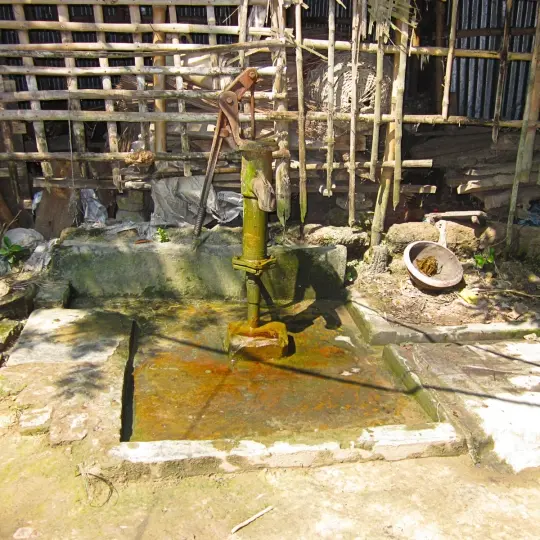
A new digital tool launched this week could help millions of people in Bangladesh avoid long-term exposure to toxic arsenic in their drinking water, without requiring a single lab test.
The app, called iArsenic, draws on a decade of groundwater research and artificial intelligence to assess the likelihood that water from a hand-pump tubewell is safe to drink. By combining user-provided information, the platform offers an instant, location-specific risk assessment for the presence of arsenic.
“iArsenic is not a replacement for chemical testing,” says lead researcher Dr Mo Hoque, from the University of Portsmouth’s School of the Environment and Life Sciences. “But it provides a first line of defence - a screening tool that anyone can use, right from their phone or PC.”
The project, developed by researchers led by the University of Portsmouth in collaboration with Curtin University, University of Dhaka, and Imperial College London, is supported by Bangladesh’s Department of Public Health Engineering (DPHE). It aims to address one of the country’s most persistent and under-acknowledged public health crises.