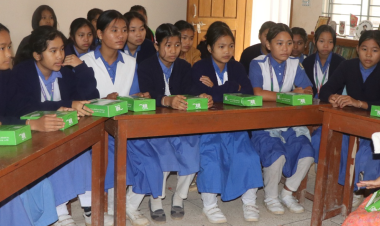
On any given day, more than 300 million women and girls are menstruating worldwide. Despite the universality of this cycle, an estimated 500 million women and girls lack access to the basic facilities required to manage their periods safely and privately. Menstrual health is often treated as a private concern. But in crisis settings, schools, and under-resourced communities, it becomes a public health, education, and dignity issue — one that shapes whether women and girls can stay safe, stay in school, and participate fully in daily life.
The gap is sharpest in emergencies, where infrastructure can collapse overnight and privacy may vanish entirely. This is period poverty: the inability to access menstrual products, safe sanitation, and the basic dignity every woman deserves.
For women and girls in conflict zones and displacement camps, managing a period is not just inconvenient. It is a monthly crisis inside a larger one. Globally, 2.3 billion people still lack access to basic sanitation services — the foundation on which menstrual health depends. From refugee camps in Bangladesh to classrooms in Ethiopia, women and girls are finding ways to manage their periods with dignity — while CARE and local communities work to expand access, break taboos, and create lasting change.
In the dense refugee camps of Cox’s Bazar, Bangladesh, more than one million Rohingya refugees live packed into a sprawling maze of makeshift shelters. Since 2017, CARE has delivered vital water, sanitation, and hygiene (WASH) services to these communities.
CARE Bangladesh also constructed 20 dedicated Menstrual Hygiene Management (MHM) blocks across Camp 15. Somima, a hygiene promotion volunteer, notes: “Before having this MHM block, we could not wash menstrual things properly. We had to bury disposables in the soil or throw them here and there. This block helped us a lot!”
That same principle guides CARE’s emergency response far beyond Bangladesh: when disaster or conflict strips away privacy, income, and access to basic services, menstrual health cannot be treated as secondary. It has to be built into response from the start.
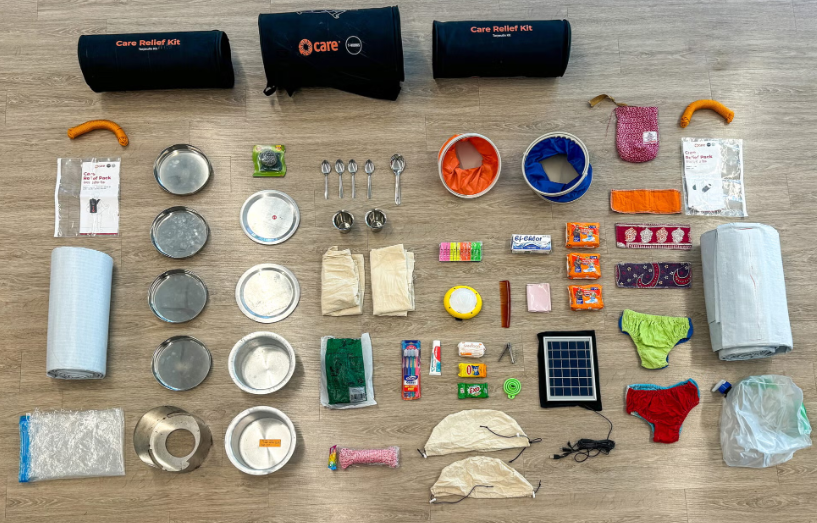
Ensuring dignity in emergencies has been central to CARE’s work since the first CARE PACKAGE® deliveries reached families recovering from World War II in 1946. Today, that legacy continues through the CARE PACKAGE® for Emergencies: a portable kit designed to help a family of four through the first critical month after disaster strikes. Each package includes a dedicated dignity kit — with sanitary pads, soap, and undergarments — because menstrual health is not a secondary need. In any emergency, it is a part of survival.