
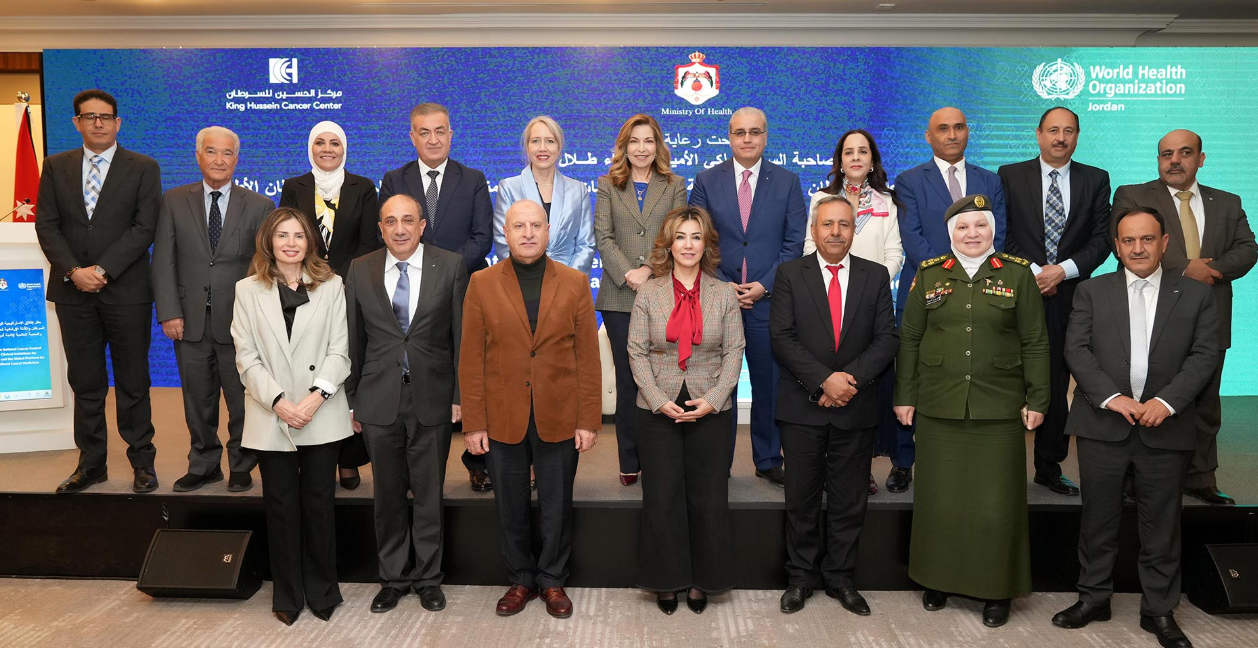
Under the patronage of Her Royal Highness Princess Ghida Talal, Chairperson of the King Hussein Cancer Foundation and King Hussein Cancer Center, Jordan commemorated International Childhood Cancer Day 2026 by unveiling three transformative national initiatives to strengthen the country’s cancer response.
The high-level event, jointly organized by the Ministry of Health and the World Health Organization (WHO), brought together partners from across the health sector, including the Jordanian Royal Medical Services, academia, the private sector and civil society. The gathering underscored a unified national commitment: no child with cancer should be left behind.
Central to the event was the launch of Jordan’s National Cancer Control Strategy 2026–2030, a comprehensive roadmap designed to enhance prevention, early detection, diagnosis, treatment, palliative care, research, surveillance and governance.
Aligned with Jordan’s Economic Modernization Vision, the strategy offers a structured, evidence-based framework to improve both the quality and sustainability of cancer services nationwide. Rather than implementing isolated interventions, it signals a shift towards a coordinated, system-wide response to deliver measurable improvements in patient outcomes.
In parallel, six national paediatric cancer clinical guidelines were introduced. Developed by a multidisciplinary national committee representing all relevant sectors, the guidelines are rooted in international best practices and tailored to Jordan’s health care context.
With technical and financial support from WHO and St. Jude Children’s Research Hospital, the guidelines aim to standardize treatment pathways across the country, ensuring that every child, regardless of location, receives consistent, high-quality, evidence-based care. This initiative represents a critical step toward reducing variations in treatment and improving survival outcomes.