
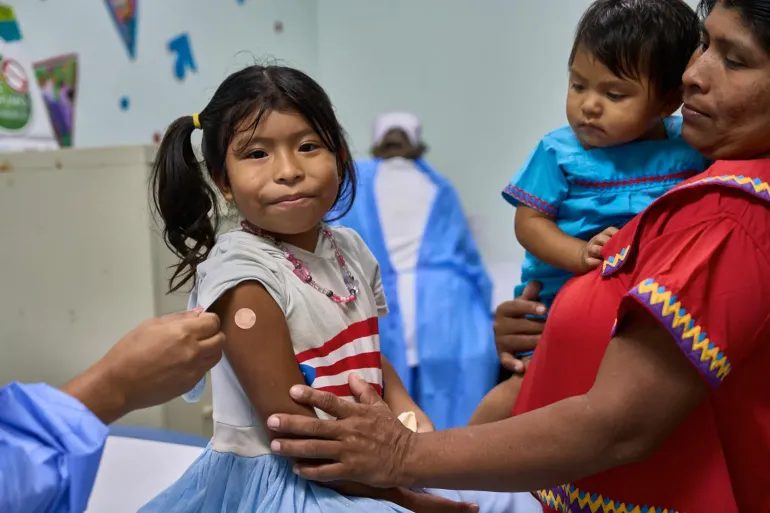
In 2025, 90 per cent of infants globally – or nearly 116 million – received at least one dose of a diphtheria, tetanus and pertussis (DTP) vaccine, and 85 per cent – or 110 million – completed the full three-dose series, according to the annual WHO-UNICEF Estimates of National Immunization Coverage (WUENIC) released today.
While both indicators rose by one percentage point from the previous year, global coverage remains one point below 2019 levels – hovering within the same narrow range since 2009.
According to the data, an estimated 13.5 million “zero-dose” children did not receive a single vaccine in their first year during 2025. While these represent nearly 750,000 fewer children than the previous year, progress is offset by a rising number of children who start the schedule and do not complete it. Most of these children live in countries where national immunization programmes receive support from Gavi, the Vaccine Alliance.
Globally, 7.3 million infants are estimated to have received their first DTP dose but dropped out before receiving their first measles dose. This drop-out rate contributed to stalled measles coverage with 84 per cent of children receiving the first measles dose (MCV1) and 77 per cent receiving the second dose (MCV2). Both figures fall far short of the 95 per cent threshold required to prevent outbreaks of this highly contagious virus. Consequently, 57 countries reported large or disruptive measles outbreaks in 2025.
“Governments and health workers have helped global vaccination rates bounce back after dropping significantly during the COVID-19 pandemic," said UNICEF Executive Director Catherine Russell. "But millions of vulnerable children are still being left unprotected due to conflict, displacement, and poverty. We must reach every child, and we must rebuild trust where it is fraying. No child should suffer from a disease that a simple vaccine can prevent.”
Data from 195 countries show that 100 countries have maintained at least 90 per cent coverage with three doses of DTP vaccine since 2019, with little progress in expanding this group. Of the countries below 90 per cent coverage in 2019, 30 improved their rates over the past six years, but 65 countries are stagnating or falling behind, including 13 fragile, conflict-affected or vulnerable countries (FCV).
Compared to their 2019 baselines, the Americas and South-East Asia have fully recovered and improved their performance, with the latter now the highest performing region. While Africa, the Eastern Mediterranean, and Europe regions saw gains last year, their coverage remains below pre-COVID-19 pandemic levels. By contrast, the Western Pacific experienced a decline, leaving it the region furthest below its 2019 baseline.