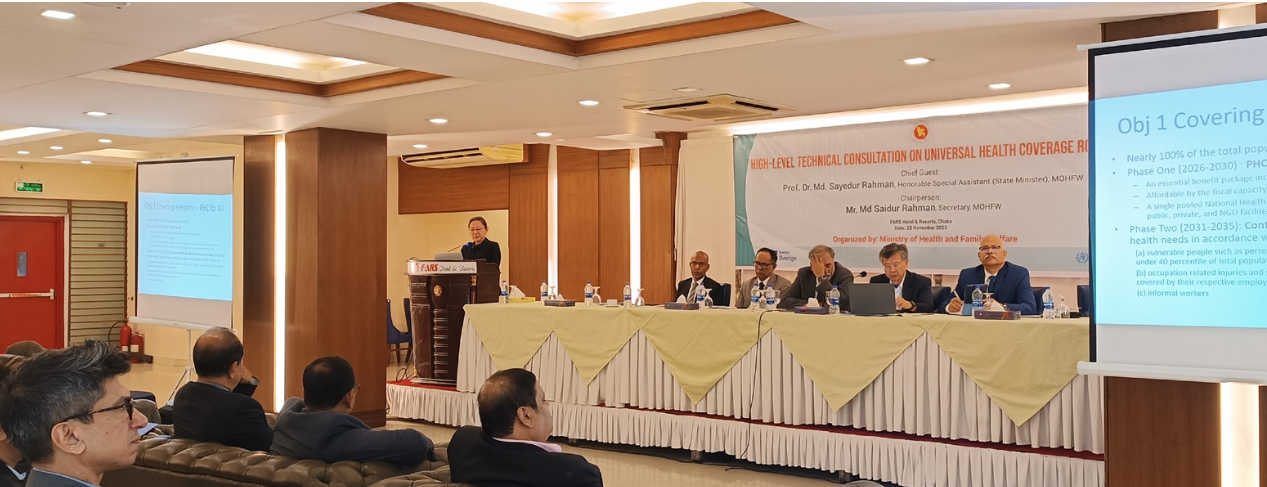
WHO convened a high-level technical consultation to present a draft of the Bangladesh Universal Health Coverage Roadmap 2026-2035.
Bangladesh has made remarkable progress in public health over the past five decades; with increase in life expectancy, sharp decrease in under-five mortality, and childhood immunization that has reached near-universal coverage. However, it still faces significant challenges. With a Universal Health Coverage service coverage index that stands at just 54 out of 100, this has resulted, in 2025, with 41.7% of the population that have experienced financial hardship due to out-of-pocket health expenditure. This amounts to about 70 million people.
It is against this backdrop, that WHO and the Ministry of Health and Family Welfare (MOHFW) jointly developed the Bangladesh Universal Health Coverage Roadmap 2026-2035
Universal health coverage (UHC) means that all people and communities receive quality health services, when and where they need them, without suffering financial hardship. UHC is not only a health goal, but also a cornerstone for reducing poverty, promoting social equity, and driving sustainable national development.
The roadmap sets out a pathway for Bangladesh to move closer to UHC. It proposes a long-term strategy grounded in the three dimensions of population coverage, service coverage, and financial protection. It is characterized by universality, a gradual and progressive approach, a single pooled fund, a comprehensive benefit package, and strong governance and accountability with political commitment. If implemented, the roadmap has the potential to transform health outcomes, reduce out of pocket expenditures and strengthen the resilience of Bangladesh’s health system.