
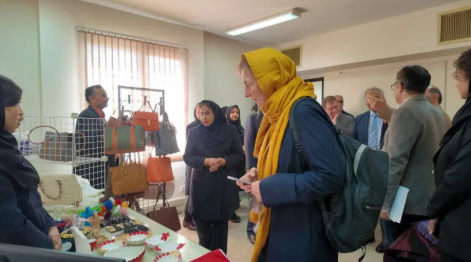
In a south Tehran neighborhood, a quiet transformation in mental health care is unfolding. Inside the Shahid Mohammad Ali Ghofrani Centre, psychiatrists, physicians, psychologists, dedicated social workers, and community volunteers work side-by-side, offering everything from psychotherapy and addiction counselling to parenting workshops and job placement assistance.
This is SERAJ – a pioneering model for integrated mental health and social care that has just been hailed by a visiting World Health Organization (WHO) delegation as an “innovative and replicable global model.”
From 8 to 12 November 2025, a high-level WHO team visited clinics, research centres and government offices across the country to witness firsthand a system that has, over decades, woven mental health into the fabric of community life. What they found was more than a success story – it was a blueprint for other nations grappling with rising mental health needs and limited resources.
At the heart of the country’s mental health strategy is the SERAJ programme – a structured three-tier service-delivery framework that integrates primary care, specialized outpatient clinics and community-based social action.
A nationwide network of approximately 5750 comprehensive health service centres, with around 3400 psychologists, serves as the first point of contact. Trained community health workers use standardized tools to screen for mental health issues, substance use and social risks. Individuals are then referred, as needed, to on-site psychologists or general practitioners for initial care.
More complex cases – such as severe psychiatric disorders, post-discharge patients, or suicide attempts – are referred to 104 specialized SERAJ centres. Each center is staffed by a multidisciplinary team, including a psychiatrist, a physician, a psychologist and a dedicated social worker who acts as a case manager.
Beyond clinical care, SERAJ centres actively engage local authorities, public agencies, charities and volunteers to tackle social determinants such as housing, employment and social inclusion. This ensures that interventions are delivered seamlessly across the health and social care systems.
“We don’t just treat symptoms – we enable individuals to contribute towards their community’s development,” explained a psychologist at the Mehrgan Centre in District 17 of Tehran, where the WHO team observed a group therapy session. “If someone is depressed, we ask: Do they have a job? A home? Family support? Without addressing these, medication alone is not enough.”
Based on programme monitoring and evaluation data, among participants of the programme there has been:
“This is community-based resilience in action,” said Dr Khalid Saeed, WHO Regional Advisor for Mental Health and Substance Abuse, who led the mission. “Iran has moved beyond a medicalized approach to one that embraces social determinants of health. This is exactly what the global mental health movement advocates.”