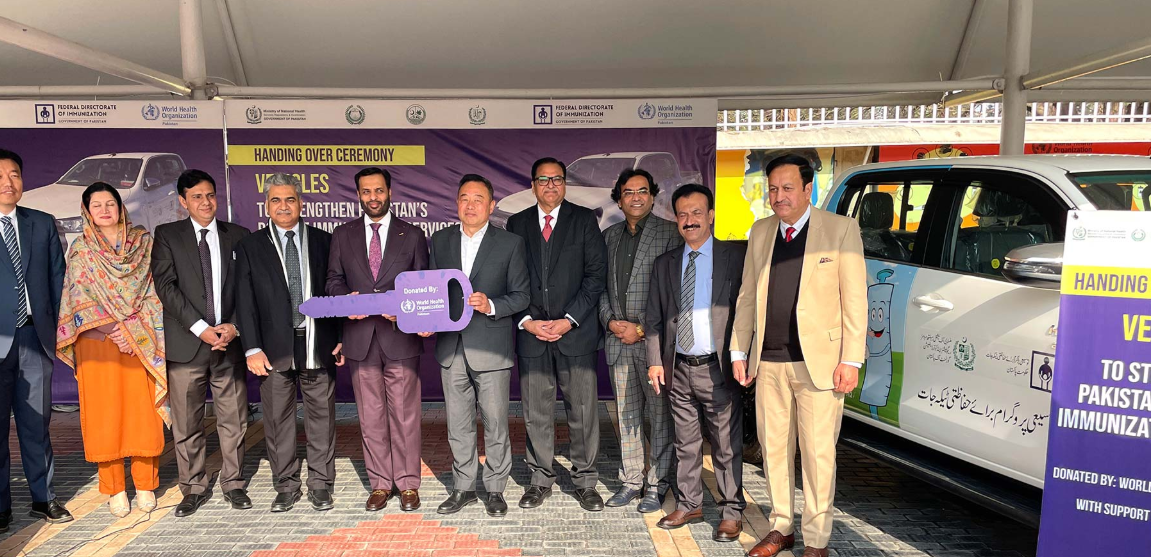
The World Health Organization (WHO) today handed over 20 four-wheel-drive (4x4) vehicles to Pakistan's Expanded Programme on Immunization (EPI) to enhance immunization activities and supervision in geographically challenging areas. The 4X4 cars will be assigned to 20 priority districts with a high concentration of children who have never been vaccinated (“zero-dose” children).
With financial support from Gavi, the Vaccine Alliance, the distribution plan allocates 3 vehicles each for Sindh, Punjab, Khyber Pakhtunkhwa, and Balochistan; 2 each for Pakistan-administered Kashmir, Gilgit-Baltistan and at the federal level; and 1 each for the Capital Development Authority and Islamabad Capital Territory.
The vehicles will address transport shortages that have previously hindered immunization performance in high-risk districts – particularly in remote areas – improving the managers’ mobility to supervise field activities directly, verify micro-plans, and ensure that vaccines are available even in the most distant communities.
“We are thankful to WHO and Gavi for this support. Our ecosystem currently faces significant challenges regarding water, sanitation, and health infrastructure, putting the health of our population at large at risk. To effectively reduce the burden of disease, it is vital that we ensure our children are vaccinated against 13 vaccine-preventable diseases. We must prioritize immunization because, ultimately, prevention is better than cure. These vehicles are to reach out to zero-dose children here in Pakistan, underprivileged people and those who do not have awareness,” said Federal Health Minister Syed Mustafa Kamal at the handover ceremony.
The new vehicles will help improve governance oversight and the supportive supervision of immunization teams, reinforcing their ability to bridge the gap between urban centres and hard-to-reach populations. The primary goal is to identify and vaccinate "zero-dose" children.
“Reliable transport is essential for effective public health work. These vehicles will enhance regular supervision and the ability to resolve logistical issues on-site. WHO remains committed to partnering with Pakistan in strengthening its immunization systems to protect every child from vaccine-preventable diseases. In Pakistan, vaccines are protecting millions of children every year, and WHO will continue to partner with Pakistan and its people to build a healthier future for all,” said WHO Representative in Pakistan Dr Luo Dapeng.