Imagine a child so weak from malnutrition that she forgets to smile. She sits on her bed, staring into space, unable to walk or play. This was 4-year-old Fatima, from a remote village in Hays district in Yemen. She was suffering from acute malnutrition bordering on the severe category. Her mother suffered along, watching helplessly as her daughter’s childhood slowly slipped away before her eyes.
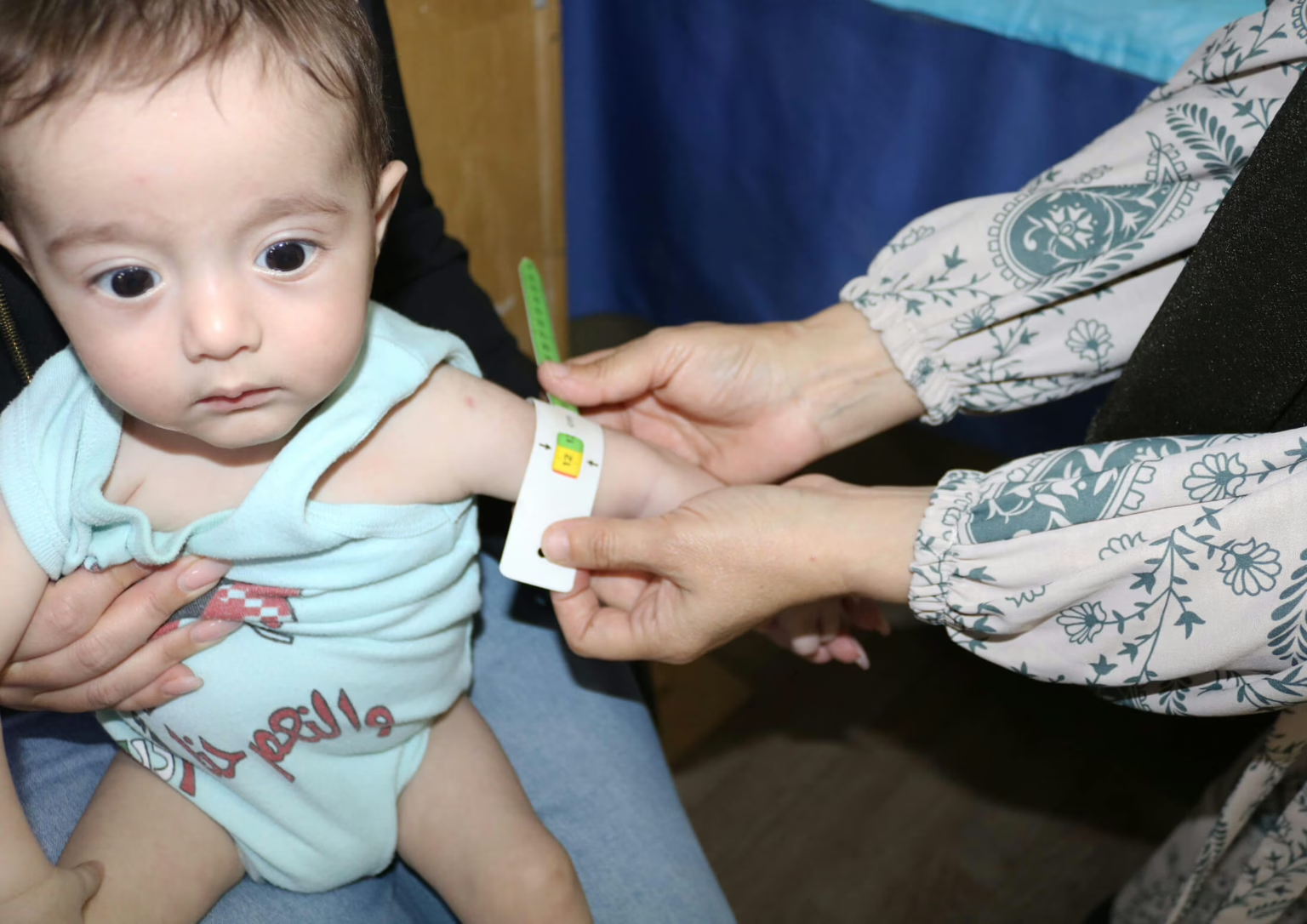
When International Medical Corps Community Health and Nutrition Volunteer (CHNV) Wad Najeeb visited Fatima for the first time during her routine door-to-door assessment, Fatima’s mid-upper arm circumference (MUAC) measured 11.8 centimeters. The normal MUAC of a girl Fatima’s age is 13.5 cm. Though the CHNV encouraged Fatima’s mother to take her to the nearest health facility for nutrition care and support, she was reluctant due to personal reasons. When Wad revisited Fatima a month later, her MUAC had slipped to 11.2 cm, which shocked Wad. She started an emergency nutrition rehabilitation plan for Fatima, and advised her mother to prepare her child’s meals using locally available ingredients, such as lentil soup with a spoonful of oil and milk products, and clean and boiled water. Her timely action and support prevented Fatima from becoming another statistic in the growing number of malnutrition-related deaths in Yemen.
More than 2,600 kilometers away, in Jordan’s Zaatari refugee camp, a 6-month-old malnourished baby visited International Medical Corps Nutrition Clinic with his mother. Hamida Alayan Al-Mohammed, 43, who works in the clinic as a Nutrition Volunteer, assessed the extremely weak child and noticed that he neither laughed nor played. Suspecting a health problem, she referred him to a pediatrician who discovered that the child had a heart defect and needed urgent surgery. The referral and Hamida’s swift action made a huge difference. The surgery was successful, and the baby is recovering.