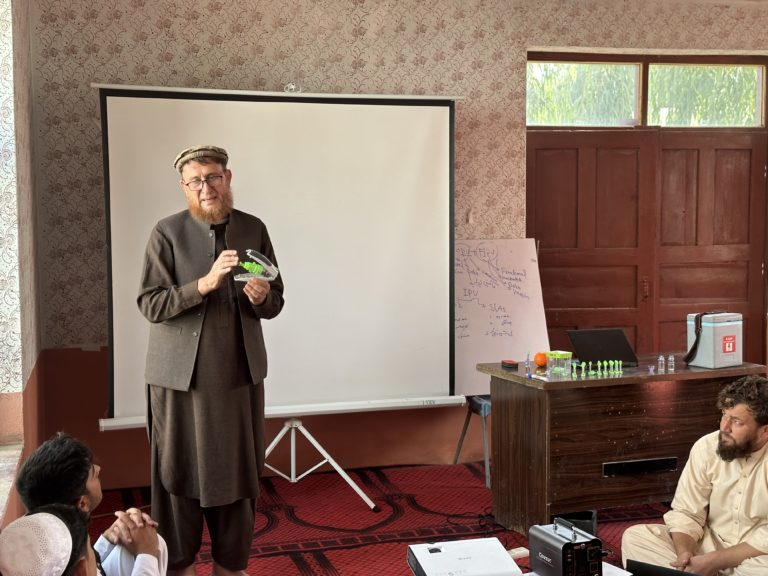
On a cloudy early morning in Afghanistan’s Laghman province, Dr Arsala set out for Alingar—a rugged, mountain-wrapped district he had visited many times before. After 12 years as a Provincial Polio Officer, he knew the rhythm of polio campaigns: the early starts, the long drives, the predictable challenges. But this time felt unusually different. This time, he carries a new tool being introduced for the first time in Afghanistan’s polio programme.
From August to October 2025, Afghanistan’s polio eradication programme launched a three-phase fractional Inactivated Polio Vaccine (fIPV) campaign across the eastern region, aiming to protect more than 1.2 million children aged 4–59 months from polio. Fifty districts, four provinces, and more than ten thousand dedicated polio workers joined forces—and uniting it all was a groundbreaking innovation never before used in the country’s polio eradication efforts.
For the first time in Afghanistan, vaccinators introduced intradermal jet injectors—needle-free devices that deliver a tiny stream of vaccine through the skin in a split second. There was no needle, no fear, and no pain. Just a quick press, a soft click, and protection delivered with a smile.
It was modern technology meeting some of Afghanistan’s most remote communities.
“This campaign is unlike any I have ever seen before,” Dr Arsala said as he held the jet injector in his hand. For him, this was not only about new technology—it was about building trust. “This is the first time such a device is being used in polio campaigns in Afghanistan. Delivering high-quality training is crucial. Vaccinators must feel confident before they go to the field.”