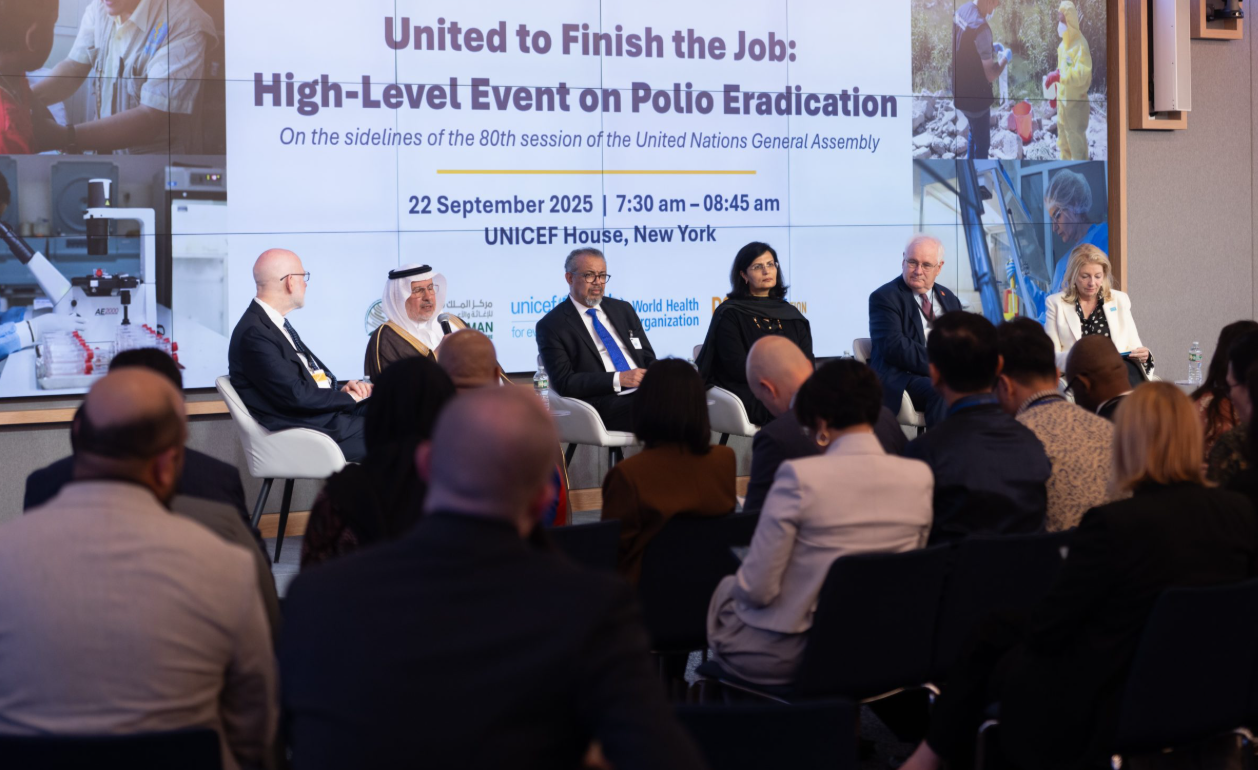
Senior global health leaders met today to discuss the final push to eradicate polio in a side event of the 80th United Nations General Assembly. The event, ‘United to Finish the Job: High Level Side-Event on Polio Eradication’, co-hosted by the King Salman Humanitarian Aid and Relief Centre (KSRelief), UNICEF, the World Health Organization (WHO) and the Global Polio Eradication Initiative (GPEI), addressed the urgent need to end wild polio transmission in Afghanistan and Pakistan while strengthening response to variant poliovirus outbreaks in fragile settings across Africa and Asia.
The high-level convening at UNICEF House brought together governments, international organizations and civil society representatives to share progress on the current state of global polio eradication. Participants discussed sustaining access to every child, building community trust and securing resources, even amid urgent humanitarian crises, from parts of Pakistan and Afghanistan to Somalia and Yemen.
GPEI partner leadership emphasized the importance of sustained funding to finishing the job, highlighting the Kingdom of Saudi Arabia’s US $500 million pledge to the GPEI, announced in April 2024. These and other critical donor funds are helping the partnership to reach hundreds of millions of children each year with lifesaving polio vaccines and end transmission of the virus for good.
Opening the event, H.E. Dr Abdullah bin Abdulaziz Al-Rabeeah, Supervisor General of KSRelief, underscored why this is a pivotal moment for global health and why the Kingdom helped convene leaders at the UN General Assembly. “Polio eradication is within reach, yet success depends on political will and sustained resources,” Dr. Al Rabeeah stated. “The Kingdom of Saudi Arabia is proud to stand with its partners to ensure that every child, wherever they live, is protected from a disease that should no longer threaten their future.”