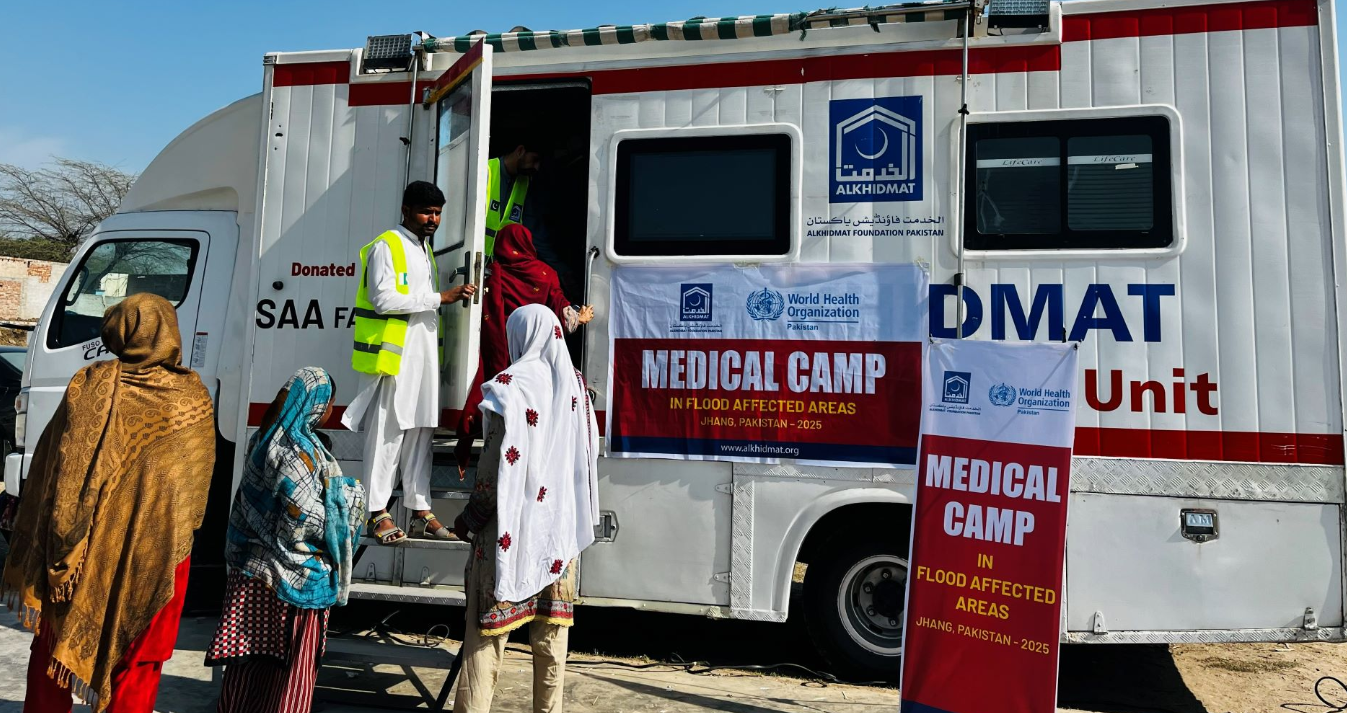
“They didn’t just bring medicine; they brought the hospital to our doorstep,” says Haider, a local farmer from Jhook Dargai village. He is one of the 250 000 people affected by the 2025 monsoon floods in Punjab who have been prioritized by the World Health Organization (WHO) to receive essential health services, as part of the response funded by the UN Central Emergency Response Fund (CERF).
Haider and his family were visited by a doctor in one of the mobile health units deployed by WHO in collaboration with the Alkhidmat Health Foundation (AKHF) and the District Government of Jhang. The intervention was designed specifically to bridge the gap for hard-to-reach communities with significant mobility and financial barriers – with particular attention to women, children, persons with disabilities, and the elderly.
For farmers like Haider, the medical camps brought new hope. “The floods took our crops and our savings. When my wife, Sakina, and our little daughter, Fatima, began showing signs of extreme fatigue and weakness, I didn’t know where to turn. The local health facilities were inaccessible, and we had no money for transport or private clinics.”
The mobile health teams performed rapid blood testing for Haider and his family – services normally unavailable in such remote areas. The tests revealed that both Sakina and Fatima were suffering from severe anaemia, a common consequence of the emergency triggered by the floods. They were immediately provided with medical counselling and essential medications, free of charge.
By providing maternal, newborn, and child health services, ultrasound diagnostics, and rapid testing at no cost, the mobile units have helped ease the financial hardship of families already pushed to the brink by the 2025 climate-driven floods.
The impact of the camp extended far beyond clinical treatment. Haider was among more than 300 community members, including students and local volunteers, who participated in intensive awareness-raising sessions. These sessions, supported by WHO Pakistan, utilized information, education, and communication materials to empower the communities with knowledge on epidemic prevention and the management of nutritional deficiencies. “The volunteers visited our homes and schools, teaching us how to protect ourselves from waterborne diseases,” says Haider.