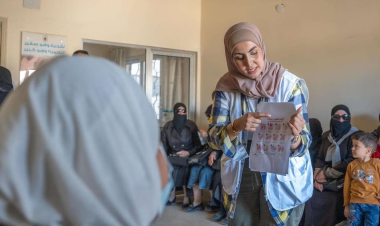
In the pediatric oncology ward of Aleppo University Hospital, nurse Nour Al-Huda Al-Yazji moves quietly between beds, checking IV lines, adjusting doses and bending down to catch the shy smiles of children who have learned to trust her.
For sixteen years, Nour has chosen to stay in this ward – a place of pain, progress and stubborn hope. She never saw nursing as “just a job”. For her, it is a commitment to walk alongside children and their families through some of the hardest days of their lives.
Recently, that commitment took her from Aleppo to Damascus, where she joined a new national training of trainers programme for pediatric oncology nurses – the first of its kind in Syria.
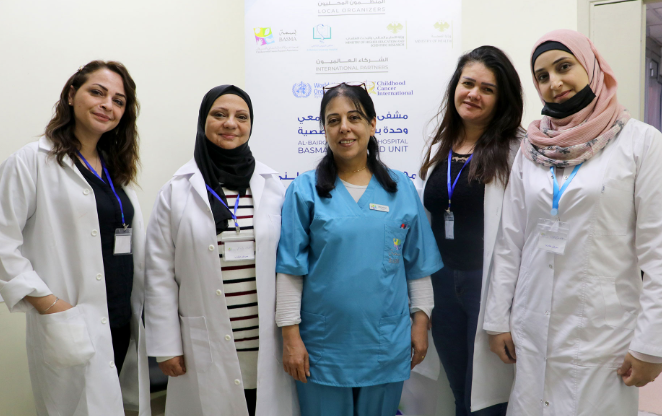
Between 26 October and 20 November 2025, nurses from pediatric oncology units across Aleppo, Idlib, Lattakia and Damascus came together at the Basma Specialized Unit in Al-Bairouni University Hospital in Harasta for an intensive course.
The programme – developed jointly by the Ministry of Health, Ministry of Higher Education and Scientific Research, Al-Bairouni University Hospital, Basma Association, and WHO, with international partners including Childhood Cancer International – aims to raise the academic and clinical skills of pediatric oncology nurses and improve the quality of care they provide to children with cancer in Syria.
Over four weeks, nurses completed 20 hours of theoretical training and 80 hours of hands-on practical work, mastering more than 80 clinical skills – from safe chemotherapy preparation and infection prevention, to managing central lines, monitoring vital signs and responding to emergencies. They also joined 40 hours of joint rounds and case discussions (clinical sessions) with the wider medical team, reflecting the reality of day-to-day work in a busy oncology unit.
The goal is clear: each nurse will return to their governorate not only more confident at the bedside, but also prepared to train colleagues, spreading up-to-date knowledge and strengthening care across the country.
“We were used to inserting lines and monitoring fluids while doctors handled calculations and decisions,” Nour explains. “During the training, we learned to understand the treatment plans themselves – what each medication does, how doses are calculated and what side effects to watch for. It changed how I see my role as a nurse.”