
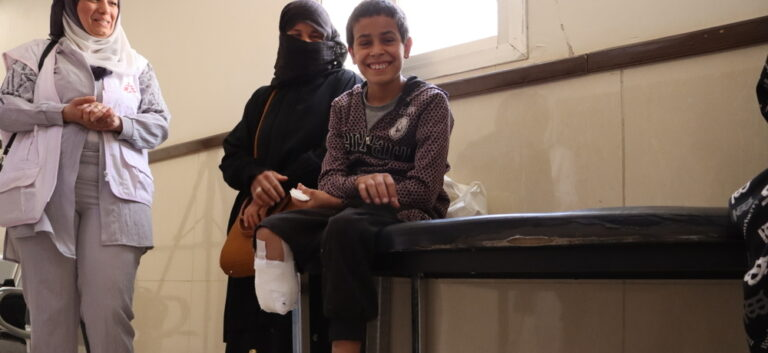
One year after Doctors Without Borders/Médecins Sans Frontières (MSF) began supporting emergency services at Deir ez-Zor national hospital (DNH), hundreds of people injured by explosive ordnance have been treated at the hospital. The number of injured highlighs the devastating and ongoing impact of contamination left behind by years of conflict.
MSF published a report Explosive Remnants of War – Lasting Harm in Deir ez-Zor, Syria on the human and health impact of explosive ordnance contamination in Deir ez-Zor governorate. It highlights the key barriers to accessing timely, comprehensive and specialized care, as well as the critical role of mine action agencies in the governorate. The report draws on MSF and the Directorate of Health (DoH) medical data, covering the period from April 2025 to April 2026, as well as operational observations and interviews with patients, caretakers and medical professionals involved in the provision of care.
“Before, I worked every day and supported myself. Now, I spend most of my time at home and I depend on my family for almost everything. If I had access to artificial limbs, maybe I could regain part of my life.”
Mohammad, a young man from Deir ez-Zor who lost both legs
Between April 2025 and April 2026, MSF and the DoH teams in the emergency room of Deir ez-Zor national hospital treated more than 215 people injured by landmines, unexploded ordnance and abandoned explosives. Nearly half of the patients were children. During this period, 24 people died from their injuries and 58 patients underwent traumatic amputations.