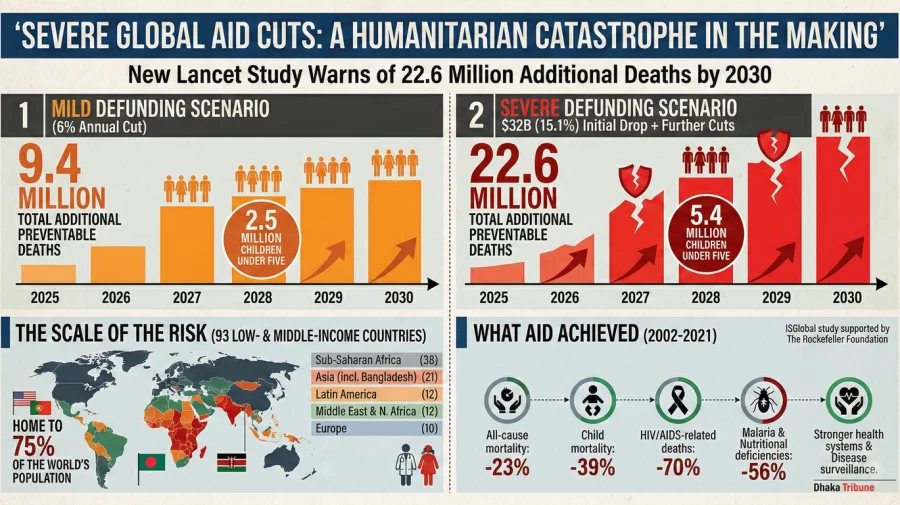
Global reductions in development assistance could reverse decades of health progress in Bangladesh and trigger nearly 23 million additional deaths by 2030 across 93 low- and middle-income countries, including 5.4 million children under five, according to a new study published in The Lancet Global Health.
The peer-reviewed analysis, led by researchers at the Barcelona Institute for Global Health (ISGlobal) and supported by The Rockefeller Foundation, warns that deep cuts to official development assistance (ODA) by major donor countries could undermine progress achieved over the past two decades in child survival, infectious disease control, and health-system strengthening.
Bangladesh is among 21 Asian countries examined in the study, alongside India, Pakistan, Afghanistan, Nepal, Myanmar, and Indonesia. Researchers note that three out of four people worldwide live in countries where gains against infectious diseases and child mortality could stall or reverse if aid reductions continue.
In 2024, international assistance fell for the first time in six years. Major donors, including the United States, United Kingdom, France, and Germany, reduced contributions, while the Organization for Economic Co-operation and Development projects a further 10%–18% decline in ODA from 2024 to 2025.