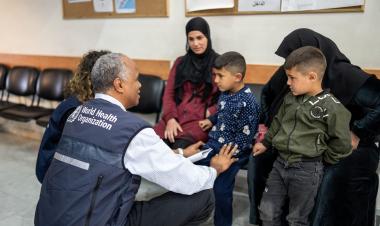
For its third global technical consultation on Public Health and Social Measures (PHSM) during health emergencies, held on 24–26 March, WHO brought together over 120 experts from 44 Member States representing ministries of health, national institutes of public health and academia as well as civil society and international organizations.
PHSM refers to nonpharmaceutical interventions that reduce the risk and scale of infectious disease transmission and lower the number of hospitalizations and deaths. Examples include symptom screening, personal hygiene measures, surface cleaning, vector control, modifications to gatherings, and domestic or international mobility. PHSM, therefore, plays a critical role in reducing the pressure on the health-care system during health emergencies, buying time to develop and distribute vaccines and treatments, and saving lives while protecting livelihoods.