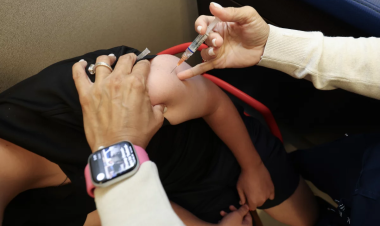

Deputy Secretary of Health and Human Services Jim O’Neill, in his role as Acting Director of the Centers for Disease Control and Prevention (CDC), today signed a decision memorandum* [PDF, 894 KB] accepting recommendations from a comprehensive scientific assessment [PDF, 1.05 MB] of U.S. childhood immunization practices, following a directive from President Trump to review international best practices from peer, developed countries.
On December 5, 2025, via a Presidential Memorandum, President Trump directed the Secretary of HHS and the Acting Director of CDC to examine how peer, developed nations structure their childhood vaccination schedules and to evaluate the scientific evidence underlying those practices. He instructed them to update the U.S. childhood vaccine schedule if superior approaches exist abroad while preserving access to vaccine currently available to Americans.
After consulting with health ministries of peer nations, considering the assessment’s findings, and reviewing the decision memo presented by National Institutes of Health Director Dr. Jay Bhattacharya, Food and Drug Commissioner Dr. Marty Makary, and CMS Administrator Dr. Mehmet Oz, Acting Director O’Neill formally accepted the recommendations and directed the CDC to move forward with implementation.
“President Trump directed us to examine how other developed nations protect their children and to take action if they are doing better,” Secretary Robert F. Kennedy Jr. said. “After an exhaustive review of the evidence, we are aligning the U.S. childhood vaccine schedule with international consensus while strengthening transparency and informed consent. This decision protects children, respects families, and rebuilds trust in public health.”
The scientific assessment compared U.S. childhood immunization recommendations with those of peer nations, analyzed vaccine uptake and public trust, evaluated clinical and epidemiological evidence and knowledge gaps, examined vaccine mandates, and identified next steps.
The assessment reviewed 20 peer, developed nations and found that the U.S. is a global outlier among developed nations in both the number of diseases addressed in its routine childhood vaccination schedule and the total number of recommended doses but does not have higher vaccination rates than such countries. In fact, many peer nations that recommend fewer routine vaccines achieve strong child health outcomes and maintain high vaccination rates through public trust and education rather than mandates. For example, in 2024, the U.S. recommended more childhood vaccines than any peer nation, and more than twice as many doses as some European nations. At the lower end is Denmark, which immunizes children against 10 diseases compared to a total number of 18 diseases for which protection was provided in 2024 in the U.S.