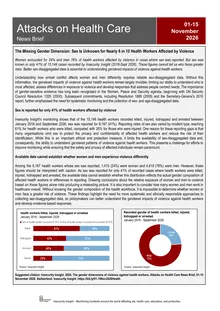
The Missing Gender Dimension: Sex Is Unknown for Nearly 6 in 10 Health Workers Affected by Violence
Women accounted for 24% and men 76% of health workers affected by violence in cases where sex was reported. But sex was known in only 41% of 15,146 cases recorded by Insecurity Insight (2016-Sept 2026). These figures cannot tell us who faces greater risks. Better sex-disaggregated data is essential to understanding gendered impacts of violence against health workers.
Understanding how armed conflict affects women and men differently requires reliable sex-disaggregated data. Without this information, the gendered impacts of violence against health workers remain largely invisible, limiting our ability to understand who is most affected, assess differences in exposure to violence and develop responses that address people centred needs. The importance of gender-sensitive evidence has long been recognised in the Women, Peace and Security agenda, beginning with UN Security Council Resolution 1325 (2000). Subsequent commitments, including Resolution 1889 (2009) and the Secretary-General’s 2010 report, further emphasised the need for systematic monitoring and the collection of sex- and age-disaggregated data.