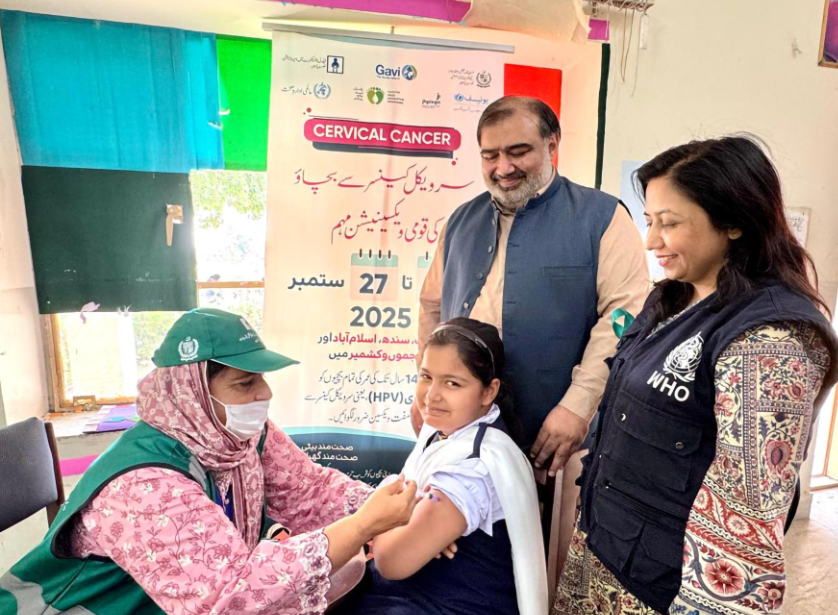
Riffat, Saira, Shaheen, and Naheed are 4 of the 49 000 health workers trained with support from the World Health Organization (WHO) who implemented Pakistan's first-ever human papillomavirus (HPV) vaccination campaign to prevent cervical cancer in 2025, protecting over 9.6 million girls aged 9–14 years.
As we mark cervical cancer awareness month, we celebrate their stories and their crucial contributions to the fight against a preventable disease that every year affects over 5000 women in Pakistan – killing 3200 of them (64%).
By battling a disinformation storm to protect millions of girls and their future families, these frontline workers achieved a historic milestone in the nation’s public health journey. They became the heroes paving the way towards ending cervical cancer for millions of women.
"Every single girl on our list is a daughter, a sister, a future leader. Our planning must be flawless to protect every one of them,” sayd Riffat Naz, a Union Council Medical Officer (UCMO) in Islamabad before the campaign began. Her team spent months conducting meticulous microplanning, creating maps and data sheets for a campaign largely focused on schools.
However, reality quickly tested these plans. Riffat’s teams faced unexpected reluctance from school administrations and a high number of parents who, influenced by online misinformation, refused to provide consent. When school-based coverage remained significantly low, Riffat had to change the approach. Her new strategy focused on reaching girls outside the classroom, redeploying teams to reassure parents at their doorstep and covering out-of-school girls in communities and nomadic settlements. “Our initial plans were challenged daily, but with the support of government authorities we were able to adapt”.